CONSORTIUM
19 Partners. One Vision.
Partners from transport companies, science and industry are working under the leadership of the University of Applied Sciences Upper Austria on the future of public transport in Austria.
Transport
Regional transport companies from four federal states implement the pilots in live operation – together with federal states, transport associations and municipalities.
Science
Research institutions and universities contribute scientific methodology, evaluation and international networking. The project is led by the University of Applied Sciences Upper Austria.
Industry
Technology companies and system providers supply vehicles, remote management systems and digital infrastructure for scalable operation.
Project Management
FH Oberösterreich
PROJECT MANAGEMENT
The University of Applied Sciences Upper Austria coordinates the overall consortium, leads the scientific research work and represents the project in national and international bodies as well as at events.
Project Partners
ALP.Lab is an independent service provider for automated and connected mobility, focusing on ADAS/AD testing, traffic and infrastructure analysis, and solutions for automated mobility. In the ROBERTA project, ALP.Lab leads the Styria & Carinthia pilot regions and contributes substantially to developing and carrying out the testing process as well as to designing the safety concept, including remote management.
In Austria, Bosch operates international competence centres for the development of forward-looking mobility technology, including in Vienna. Almost half of the company’s 3,300 employees in the country work in engineering, developing innovative solutions for connected mobility and artificial intelligence. In the ROBERTA project, Bosch contributes expertise in charging planning for electric buses, vehicle connectivity and cybersecurity.
The University of Applied Sciences Upper Austria is Austria’s most research-intensive university of applied sciences, with four campuses and 75 bachelor’s and master’s degree programmes. Its research aims at direct implementation in business and society. The Logistikum in Steyr is a national leader in interdisciplinary research on logistics, mobility and automated driving.
With a 165-year history, the GKB is Austria’s largest private railway and a key local-transport mobility provider for western and south-western Styria. The company operates three suburban railway lines, RegioBus lines and rail freight transport, carrying over 6 million passengers per year. By participating in ROBERTA, the GKB continues its tradition of innovation in autonomous driving.
JOANNEUM RESEARCH is a non-university research company owned by the provinces of Styria, Carinthia and Burgenland. Around 500 employees at six locations develop solutions for society, business and industry. In ROBERTA, the Digital Twin Lab contributes expertise in simulation-capable digital twins and UHD maps and integrates data for monitoring and optimising autonomous operation.
The OÖVG is the central organisation for planning, coordinating and developing public transport and multimodal mobility services in Upper Austria. In the ROBERTA project, the Upper Austria Transport Association handles the detailed planning of the pilot route in Upper Austria and integrates the pilot application into the association’s passenger information and ticketing. It also implements targeted communication measures and ensures passenger information through existing transport information systems.
Founded in 1935, Wilhelm Welser Verkehrsbetriebe GmbH is a family business in Upper Austrian local public transport. As a partner of the Upper Austria Transport Association, the company runs an extensive route network with a modern vehicle fleet. In the ROBERTA project, the company operationally implements the test operation of highly automated buses in Hagenberg and contributes to preparing autonomous scheduled service.
ANDATA is an Austrian technology company that has been working since 2004 in artificial intelligence and scenario-based approaches for developing, validating and releasing complex control systems. Its expertise covers integral vehicle safety – from passive and active safety to automated driving. In ROBERTA, ANDATA leads requirements analysis and system design.
Digitrans is an Austrian competence centre for automated driving, offering specialised consulting, testing expertise and an intelligent test environment for passenger and freight transport. The test centre features an outdoor rain facility for reproducible rain tests of sensors and assistance systems. Digitrans also supports the development and testing of driverless mobility applications.
Gerald Windisch / eMobility consult has been an independent partner for mobility transformation in combination with renewable energy and digitalisation for over a decade. Its focus areas are electromobility, smart logistics concepts, automated mobility in the DACH region, and vehicle-to-grid and vehicle-to-X technologies. The company supports companies, regions and institutions with a holistic consulting approach.
Innsbrucker Verkehrsbetriebe und Stubaitalbahn GmbH (IVB) is Innsbruck’s municipal transport provider and mobility coordinator. The company ensures reliable and punctual mobility around the clock, 365 days a year, thereby contributing to sustainability in the city. Within ROBERTA, the IVB is responsible for operating the autonomous test route in Innsbruck.
KEBA Group AG, headquartered in Linz, is an internationally active specialist in industrial automation solutions. In the ROBERTA project, KEBA contributes its experience in developing safety-critical automation systems. Its central task is the design, development and evaluation of a passenger assistance system for automated buses, ensuring safe and user-friendly operation in public transport.
The SCCH is an independent research centre for software and data science with around 120 employees from 18 nations. As a COMET centre, it is supported by the federal government and the Province of Upper Austria. In the project, the SCCH handles requirements gathering and KPI definition as well as technical evaluation, data analysis and the assessment of real operating data during live bus operation.
Business Upper Austria is the location agency of the Province of Upper Austria. In the project, the Automobile Cluster supports the Austrian vehicle industry through knowledge building and transfer, knowledge transfer from predecessor projects, networking ROBERTA with SAAM Austria, supervising the Upper Austrian pilot region together with Digitrans, and disseminating the results.
Dr. Andreas Eustacchio, LL.M., is a lawyer and legal expert at the interface of autonomous driving and artificial intelligence. In the project, he leads the legal framework (Automated Driving Ordinance, GDPR, cybersecurity), the evaluation of the legal framework, and the development of recommendations for the large-scale implementation of autonomous driving in Austria.
The Graz Energy Agency (GEA) promotes energy efficiency and renewable energy for climate protection and regional value creation. As a research institution, it develops sustainable solutions in mobility, buildings and energy systems. In ROBERTA, the GEA leads the evaluation work package, embeds gender & diversity as well as sustainability, develops charging optimisation, and supports the AREA Süd in preparing and implementing the pilot operation.
As an experienced designer, Irene Fuchs is responsible for the project’s visual communication, both internally and externally. Her tasks include conceiving and producing information materials in print and online for partners and pilot regions, as well as the clear visualisation of project results and processes.
The KFV (Austrian Road Safety Board) was founded in 1959 and has been committed to accident prevention and safety in Austria for more than 60 years. In ROBERTA, the KFV carries out a needs and requirements analysis, conducts surveys and interviews on user satisfaction and acceptance, and develops practical recommendations for optimising operation, service quality and communication processes.
Virtual Vehicle Research GmbH (ViF) is a leading research centre for vehicle technologies and automated driving. In the ROBERTA project, ViF develops data-driven methods for analysing, evaluating and validating automated buses, as well as for integrating, simulating and validating innovative systems in real operation. The goal is safe, scalable and sustainable deployment in public transport.
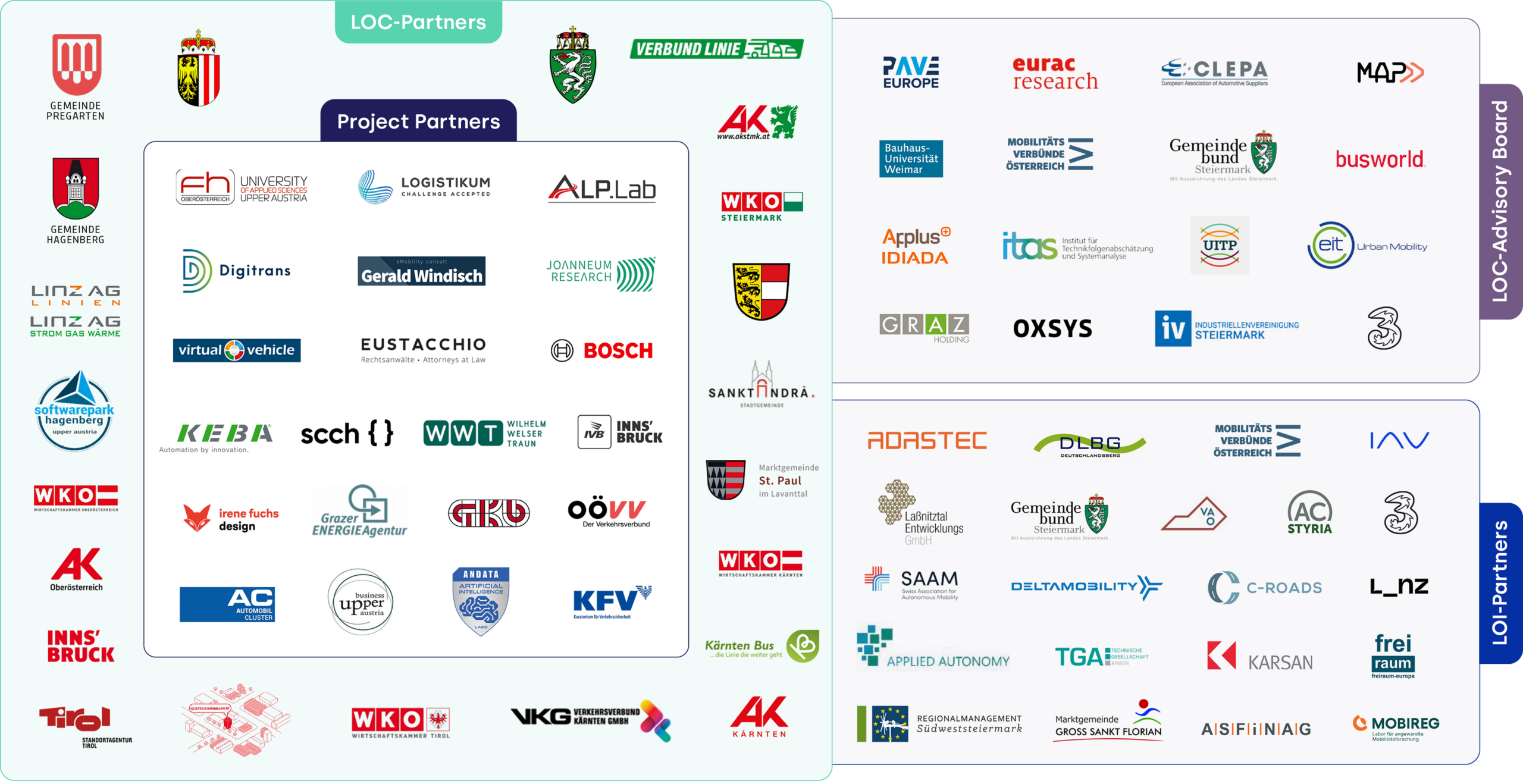
LOC Partners
Letter of Commitment
Funding Bodies
Testing automated public transport mobility under real-world conditions in long-term operation across various pilot regions yields insights for a rapid, efficient and Austria-wide implementation of automated mobility in public transport, and thus for creating a sustainable mobility offering. Automated buses can be an attractive alternative to the private car – particularly for short distances or daily commutes – and thus help reduce emissions and traffic load. In sparsely populated areas, public transport is often limited or entirely absent. Automated buses enable flexible, demand-driven trips, connecting even remote locations better and thereby improving accessibility. The central benefit of ROBERTA for funding bodies lies in evidence-based results that support decision-making when scaling the automated mobility of the future. In this way, long-term prosperity can be created through mobility infrastructure.
Social Partners
From the perspective of the social partners (Chamber of Labour and Chamber of Commerce), the benefit of ROBERTA lies in securing and creating jobs and increasing the competitiveness of the Austrian economy. On the one hand, this is achieved by strengthening regional development. Better transport connections can increase the attractiveness of rural regions – for housing, tourism and the local economy. At the same time, new fields of work are emerging in maintenance, operation and data management. On the other hand, this strengthening comes through guaranteeing mobility for all (avoiding mobility poverty). Older people, young people, those without a driving licence or people with reduced mobility particularly benefit from a reliable, barrier-free offering. Automated buses can help promote social participation and prevent isolation.
Additional LOC Partners
The scope of the additional LOC partners – i.e. neither funding bodies nor social partners – ranges from bus operators, transport associations and infrastructure support to all the municipalities involved in the pilot operations. Only through this strong support will it be possible to carry out all operations in the four pilot regions as planned.
Advisory Board
With its broadly international advisory board, we create the conditions to make ROBERTA visible beyond Austria’s borders at a very early stage. Through ongoing international dissemination, scientifically relevant topics are to be discussed in detail with experts from ROBERTA, thereby underpinning the expertise of Austrian stakeholders. The project advisory board is seen as an essential key for ROBERTA to learn quickly and continuously from international flagship projects and experts. It is also an important lever for exploiting the project results for each partner as well as for the project as a whole. In composing the board, great importance was placed on the diversity of disciplines and expertise. The advisory board is integrated into the project every six months.
LOI Partners
Letter of Intent
During the preparation of the project, a high level of interest was shown. In addition to partners who signed an LOC with concrete contributions, there were numerous stakeholders who either want to stay informed or also wish to offer concrete contributions to the project. Among others, vehicle manufacturers showed strong interest and underlined this with a signed LOI.